

Industry insights
6 Best AI Voice Agents for Customer Support
Best AI Voice Agents for Customer Support (2026 Comparison)
Industry insights
Best AI Voice Agents for Customer Support (2026 Comparison)
Last updated
Support organizations are transitioning from experimental voice automation demos to real-world usage. In real-world environments, the difference between an effective AI voiceAI voiceAn artificially generated, natural-sounding voice produced by a TTS model. Thoughtly supports a library of AI voices and brand-specific cloning. agent and a frustrating one comes down to conversation handling: interruptions, path changes, silence, and operational actions during and after the call.
The platforms below are the strongest AI voice agents in customer support, spanning customers ranging from lean, workflow-driven teams to large enterprise call centers.
Customer support teams are using AI voice agents for many use cases today such as basic triage, order lookups, routing, and repetitive requests that suck up human agent time. What matters most is that voice agents can handle real calls and execute actions safely and escalate cleanly.
Before choosing a platform, customer support teams should pressure test options against the following criteria:
Customer support calls can take many different turns. Customers pause, change their minds, and interrupt agents. Production-ready voice agents need to be able to manage natural turn-taking, detecting interruptions, understanding silence, and reacting quickly when conversations deviate from the expected path. Strong conversation flow is important for ensuring calls don’t feel scripted.
Customer support voice agents are only effective if they feel real-time. Delays, even if short, can break trust and cause callers to hang up. The best voice platforms optimize for low-latency response generation and natural text-to-speech delivery. Sub-second response times are critical for maintaining flow of conversation.
Effective voice agents need to be able to handle a variety of support tasks. This includes triage, policy explanations, status checks, and escalation when edge cases appear. The best voice agentVoice agentAn autonomous, conversational interface that interacts with humans over the phone — answering, qualifying, and routing calls without human staffing. platforms are capable of executing both structured workflows and open-ended conversations, allowing agents to adapt as calls shift.
Voice agents are only as capable as the actions they can perform. This means integrating with CRMs, ticketing systems, identity systems, and internal tools to complete cross-system actions. Whether retrieving account details or triggering follow-up workflows, tight integrations allow voice agents to effectively complete tasks as part of the support operation.
| Platform | Best fit | Primary strength | Watch for |
|---|---|---|---|
| Thoughtly | support voice automation | Voice plus SMS/email follow-up, CRM write-back, scheduling, routing, and workflow execution | Requires clear qualification, escalation, and system-of-record rules |
| Genesys Voicebots | support voice automation | Enterprise contact-center platform and routing ecosystem | Can be heavyweight for teams prioritizing fast revenue-agent deployment |
| Google Dialogflow CX + Contact Center AI | support voice automation | Google-native conversational AI for support flows | Needs implementation work to become a complete workflow layer |
| Five9 Inference Studio | support voice automation | Enterprise CCaaS and contact-center operations | Often broader than buyer teams need for dedicated lead conversion |
| Retell AI | support voice automation | Configurable voice AI infrastructure with strong voice quality | Usually needs technical assembly for full revenue workflows |
| Synthflow | support voice automation | No-code builder for structured voice workflows | Works best when call paths are clearly modeled and maintained |
Best For: Workflow-driven customer support voice agents capable of executing tasks across systems
Best For: Contact center support automation within the Genesys ecosystem
Best For: Support organizations building custom voice agents on Google Cloud
Best For: Five9 contact center customers adding AI-driven voice automation to existing operations
Best For: Developer teams building custom voice support agents
Best For: Small teams or pilots looking to deploy simple support phone agents quickly
Less suited for complex workflows or large-scale operations
When choosing a voice agent platform, it’s often smart to start with how your organization actually operates. Customer support operations vary widely; what works for a high-volume call center may not work for an ops-heavy team focused on tickets.
The table below maps common support environments to the capabilities that matter most in practice.
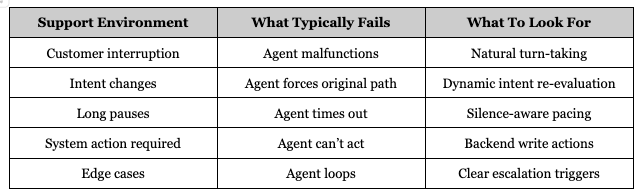
When AI voice agents are designed for real conversations, they can significantly improve customer support operations. Platforms that handle interruptions naturally, respond quickly, and integrate deeply with systems often succeed in real-world environments.